
Gift Economy Retreat: Why There Is No Set Price for NAKED
Important update: NAKED no longer runs on a gift economy. In the section “What has changed” below, we explain what we do today. The rest of this article explains the idea behind the gift model and why it shaped NAKED for so many years.
For years, people asked us the same question: why is there no set price for NAKED? The short answer is that we were trying to practise something we believed in. The longer answer starts with a writer and thinker called Charles Eisenstein.
Where the idea comes from: Charles Eisenstein
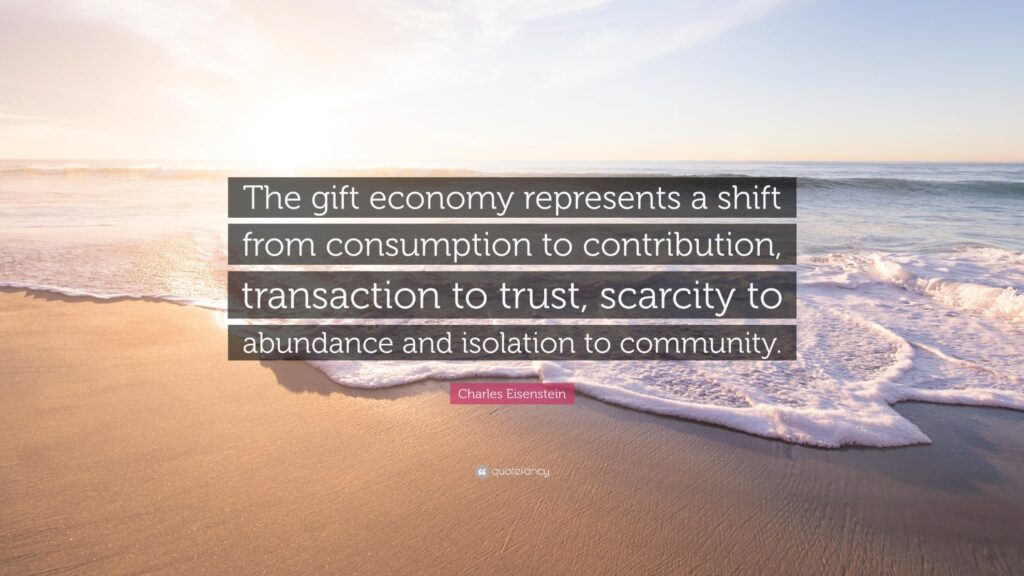
Charles Eisenstein is an author and speaker who writes about money, society and what he calls the story of separation. His book Sacred Economics: Money, Gift, and Society in the Age of Transition looks at how money shapes our relationships and asks whether we can move toward an economy based more on generosity, trust and connection.
The heart of the gift economy is a simple shift in perspective. In a normal transaction, two parties exchange things of equal value and the relationship ends there. Once the price is paid, nobody owes anything. In a gift economy, something is given freely, and the gift creates a relationship. The receiver feels gratitude, and often wants to give something back, not to the same person but forward, into the world. The gift keeps moving.
Much of what you read below is inspired by and adapted from his work. We are not experts on economics, and we never claimed to be. We simply found his ideas so inspiring that we wanted to test them in real life.
Why we tried a gift economy at a naked retreat
At NAKED we strip things away: clothes, roles, stories, identification and attachments. When Dara and Simon started the first retreat in Malta in 2014, it felt natural to look at one more layer: our relationship with money.
Money is one of the biggest sources of shame, fear and comparison in many people’s lives. It decides who can join, who feels worthy and who feels judged. We wanted at least one space where that was different. That does not mean it was free. It meant it was self-determined.
How the NAKED gift model worked
There was no fixed price for the retreat. Instead:
- Participants paid an initial contribution that covered the fixed costs, such as accommodation, food, materials and a chef. We did not make a profit on it.
- At the end of the retreat, each person was invited to gift forward whatever felt right, to support the community and the continuation of NAKED.
- If someone’s financial means were limited, they could choose a token amount or even zero.
- We offered one or two scholarships on each retreat. The deposit for room and board was gifted by us and the community, and the person chose what to gift at the end.
The questions we always got
“It’s a gift, but how much do you really want?”
We understood this. A gift with a hidden price is not a gift. That is why we asked people to look at their own situation instead of guessing what we wanted.
“This retreat is worth 2,000 to 3,000 euro. Why not just charge for it?”
Because a fixed price, whatever it is, leaves some people out and makes the exchange purely transactional. We wanted people to feel the difference.
“If you want to make it accessible, offer it for free.”
The problem with free is that people don’t always value it. They can arrive with low expectations and low commitment. We also wanted to honour the months of work that we and our small team put into every retreat.
How to choose your amount
We asked people to choose an amount that felt right, given:
- their financial means
- the value they received after the experience
- similar retreats on the market
- what represents a gesture of gratitude
- their wish to support our continued work
We suggested an amount that represents a commitment to fully engaging with the retreat, or one that, perhaps inexplicably, felt fair, clean and honest.
Message before money
If someone felt uncomfortable paying zero, we wanted them to know that we held no negative judgement. We remember how it felt to be broke and unable to join things that were outside our ability to afford. We remember the feeling of injustice and the cynical thought that teachers care more about money than about teaching. Anyone in that place was sincerely welcome.
What the gift economy taught us
- Trust works, and it is demanding. Some people got the model instantly. For others it was hard to understand, and that is fine.
- Generosity often comes back in unexpected ways. Many people gave more than we ever asked for, and many gave in other forms: time, skills, help with the community.
- Money is never only money. It touches worth, fear, fairness and belonging. Talking about it openly was as valuable as the practices themselves.
- It is hard to sustain. A model that depends on trust and on everyone giving what they can needs a lot of energy and a very stable base.
What has changed: we no longer run NAKED as a gift economy
We want to be clear and honest: NAKED the retreat is no longer offered as a gift economy. Since the change, retreats and events have a fix price and we offer discounts for people who feel challanged by the financial aspect of joining our offerings.
What stays the same:
- The values. We still believe in generosity, equality, trust and honesty around money.
- Accessibility. We still offer spaces for people who are not able to pay the full price.
- The community. The NAKED community is still built on giving and receiving. Many of the gifts people bring, such as time, skills and care, do not have a price.
If you have questions about current prices or about joining with limited means, write to us. We are happy to talk about it openly.
Frequently asked questions
Does NAKED still have no set price?
No. NAKED is no longer a gift economy. See the section above for how it works today.
Who is Charles Eisenstein?
An author and speaker known for Sacred Economics and his writing on gift economies and community. Our earlier gift model was inspired by his work.
What is a gift economy?
A gift economy is a system where things are given freely, without a fixed price or immediate exchange, and where the gift creates relationships and encourages giving forward.
Was the retreat free?
No. There was an initial contribution for the fixed costs, and people chose what to gift at the end. Nobody was turned away for lack of money.
Can I still join with limited means?
Yes, please reach out to us and we chat.
Continue reading
This article is inspired by and adapted from the work of Charles Eisenstein: charleseisenstein.org.